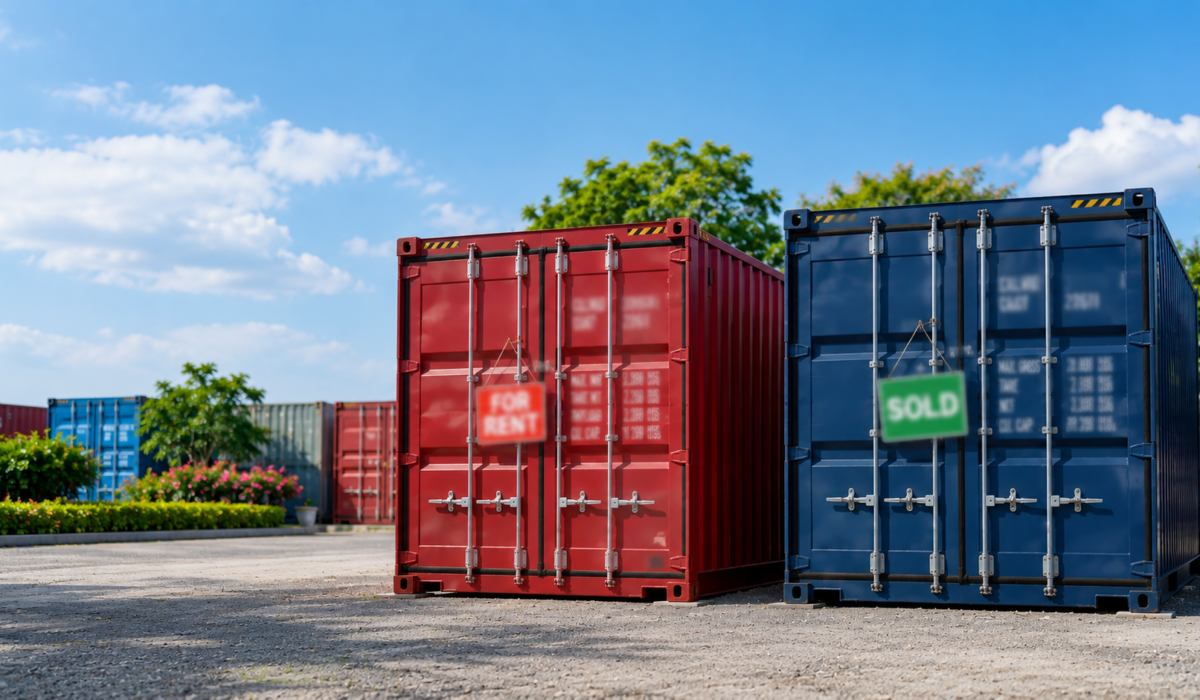
Should You Rent or Buy a Shipping Container? The Real Break-Even Math
Updated August 30, 20265 min read
On This Page
Most guides on this question hand you a list of pros and cons and leave the actual decision to you — flexibility versus ownership, low upfront cost versus long-term value. That’s not wrong, but it’s not that useful either, since it doesn’t answer the actual question: at what point does buying become cheaper than renting? This guide runs the real numbers, building on the mechanics already covered in our rent-to-own guide and lease-to-own guide — this piece is specifically about the rent-vs-buy decision itself, not how either path works mechanically.
The Three Real Options
Before running any numbers, it’s worth being clear about what you’re actually choosing between:
Straight rental — pay monthly, return the container when you’re done, build zero equity
Buying outright — pay the full price upfront (cash or a personal loan), own it immediately
Rent-to-own or lease-to-own — a middle path covered in detail in our other guides, where monthly payments eventually convert to ownership
This article focuses on the first two, since that’s where the real “which is cheaper” math lives. If your actual constraint is credit access or avoiding a large upfront payment, the rent-to-own path is worth reading about separately.
The Break-Even Framework
YES Containers’ 2026 analysis runs real container pricing against rental rates to find the actual break-even point, rather than leaving it as a vague feeling. Their finding, based on current market pricing: for storage needs under 3-6 months, renting is cheaper; in the 12-15 month range, the two options land within a few hundred dollars of each other; and at 18 months or longer, buying is almost always the cheaper path, with the advantage growing the longer you keep the container.
Here’s that same logic applied to a simple, illustrative example — a mid-size container renting for $120/month against a $3,000 purchase price:
Duration of use
Total rental cost
Purchase cost
Cheaper option
6 months
$720
$3,000
Rent
12 months
$1,440
$3,000
Rent
25 months
$3,000
$3,000
Break-even
36 months
$4,320
$3,000
Buy
48 months
$5,760
$3,000
Buy
(Calculated by ConexGuide using the $120/month and $3,000 figures as an illustrative example; actual rental rates and purchase prices vary by size, condition, and region — recalculate with your own quoted numbers before deciding.)
The break-even point in this example lands around 25 months — a bit later than YES Containers’ general 18-month pattern, and that gap is worth explaining rather than glossing over: their analysis factors in resale value, since a container you eventually sell recovers some of your purchase cost, effectively lowering the true cost of buying and pulling the break-even point earlier. The simple table above doesn’t account for resale, so treat it as a conservative, worst-case comparison — your real break-even point is likely somewhat sooner than a pure cost table shows.
What the Break-Even Math Doesn’t Capture
Cost isn’t the only factor, and a few sources make this point well.
Flexibility to change size or type.Dry Box’s guide notes that renting lets you switch sizes or container types if your needs change, while buying locks you into whatever you purchased unless you buy again. If your storage or space needs are genuinely uncertain, this flexibility has real value beyond what the pure cost math captures.
Maintenance and transportation responsibility. The same source points out that owning a container means you’re responsible for its upkeep and eventual transportation — rental providers typically handle delivery and pickup as part of the service, which is a real convenience cost saving that doesn’t show up in a simple price comparison.
Resale value works in your favor over time.PODS’ comparison guide notes that containers tend to retain value reasonably well, and ownership makes sense specifically when the cost of purchasing will be offset within your actual usage timeframe — which is really just another way of framing the break-even question, but worth having confirmed by a second source.
A hybrid approach exists for uncertain or scaling needs.Container One’s guide notes that some buyers use a combination — renting to handle short-term or uncertain overflow needs while owning a core unit for permanent, predictable use. This is worth considering if your situation doesn’t fit neatly into “definitely short-term” or “definitely long-term.”
A Quick Way to Decide
Using it for under 6 months, or genuinely unsure how long you’ll need it → rent
Confident you’ll use it 18+ months, or need it permanently → buy
Somewhere in the 12-15 month range → run the actual numbers with your specific quotes, since this is where the decision is genuinely close
Need flexibility to change sizes, or want to avoid maintenance/transport responsibility → renting’s non-cost advantages may outweigh a modest cost difference
Uncertain, scaling, or mixed short-and-long-term needs → consider a hybrid approach rather than treating it as all-or-nothing
Frequently Asked Questions
At what point does buying become cheaper than renting a shipping container? It depends on your specific rental rate and purchase price, but real market analysis puts the general pattern at roughly 18 months as the point buying starts winning, with the gap widening the longer you keep the container. Run the math with your own quotes for an exact number, since prices vary by size and region.
Does container resale value change this calculation? Yes, meaningfully — since a container retains resale value, the effective cost of buying is lower than the sticker price once you eventually sell it, which pulls the break-even point earlier than a simple rent-vs-purchase-price comparison suggests.
Is rent-to-own a better option than either renting or buying outright? It depends on your priority. Rent-to-own is worth considering specifically if credit access or avoiding a large upfront payment matters more to you than minimizing total cost — see our dedicated guides for how that path actually works.
What if I’m not sure how long I’ll need the container? When duration is genuinely uncertain, renting is usually the safer starting choice, since the downside of over-committing to a purchase (paying for a container you no longer need) is generally worse than the modest cost premium of renting a bit longer than strictly necessary.
The Bottom Line
The rent-or-buy decision isn’t really about opinions or general flexibility-versus-ownership tradeoffs — it comes down to a specific number: how long you’ll actually use the container, compared against your specific rental rate and purchase price. Run the real math with your own quotes rather than relying on generic guidance, and the right answer usually becomes obvious.