Shipping container insulation cost: what each method adds to a 20ft or 40ft box
On this page
Insulation is priced by the square foot, so the first job is counting square feet. A standard 20-foot container measures about 19 ft 4 in by 7 ft 8 in by 7 ft 10 in inside, according to ItemFits, and its walls and ceiling add up to roughly 570 square feet. A 40-footer has about 1,040. With those two numbers, shipping container insulation cost stops being a vague question and turns into multiplication.
The counts include both long walls, both ends and the ceiling, and treat the door end like any other wall. They leave out the floor. A high cube is a foot taller inside (about 8 ft 10 in, per ItemFits), which adds roughly 55 square feet to a 20-footer and 95 to a 40-footer.
For prices, HomeGuide publishes installed costs per square foot by insulation type. Those figures come from house projects, so treat them as the closest neutral numbers available for a steel box. For comparison, HomeGuide’s container home cost data puts insulation for a finished container home at $1,000 to $8,000. Everything below is that per-foot pricing multiplied by the areas above.
Under about $1,200 on a 20-footer: a reflective layer
The cheapest line in the price list is a radiant barrier or reflective insulation, at $0.30 to $2.00 per square foot installed. On a 20-foot container that comes to about $170 to $1,140. On a 40-footer it is about $310 to $2,080. People searching for bubble insulation for a shipping container are usually looking at this tier.
The low price reflects how little it does. HomeGuide says a radiant barrier blocks only radiant heat, the kind a sun-baked roof throws down at you. Reflective insulation adds an insulating layer behind the foil and picks up an R-value between R-3 and R-21, depending on the product. Conexwest, a container seller, adds that reflective foil works best in hot climates when it is installed with an air gap.
So this tier answers one question, summer heat. It does little for winter heat loss, and on its own it does not stop condensation. If a hot roof is the whole problem, it may be all you need.
$460 to $1,480 on a 20-footer: batts in a framed wall
Batt and roll insulation runs $0.80 to $2.60 per square foot installed, which gives about $460 to $1,480 for a 20-footer and $830 to $2,700 for a 40-footer. Doing it yourself brings the material alone down to $0.30 to $1.30 per square foot for fiberglass, or about $170 to $740 on a 20-footer.
Batts need something to sit in, though. In a steel container that means studs fastened to the walls, and neither the studs nor a vapor barrier are in the per-foot price. A 2×4 wall gives a 3.5-inch cavity. At the 2.2 to 2.9 R-value per inch that HomeGuide lists for fiberglass, the cavity holds about R-7.7 to R-10.2. That figure is a rough calculation, not a guaranteed rating, because the R-value depends on the specific batt. Denser batts carry higher ratings, and HomeGuide’s own R-13 to R-15 recommendation for garage walls lists batts among the options. Check the manufacturer’s stated R-value for the actual batt and the depth of your cavity.
Moisture is the risk with this tier. HomeGuide notes that wet insulation loses its R-value and often leads to mold, and it adds that fiberglass needs replacing more often than rigid materials. Conexwest recommends a vapor barrier over the insulation and says ventilation is essential to keep humidity down. Both belong in the budget when you choose batts.
$860 to $2,570 on a 20-footer: spray foam
Spray foam costs the most per square foot of the three. HomeGuide’s comparison table lists $1.00 to $4.50 installed, and its spray foam section lists $1.50 to $5.00. The two ranges overlap between $1.50 and $4.50, so that is the range used here: about $860 to $2,570 for a 20-footer and $1,560 to $4,680 for a 40-footer.
The low end of the 20-foot figure is unlikely to hold. HomeGuide says some insulation companies charge a minimum project fee of $1,500 to $2,000 or more, and a container is a small job. For contractor-installed foam on a 20-footer, plan on at least $1,500.
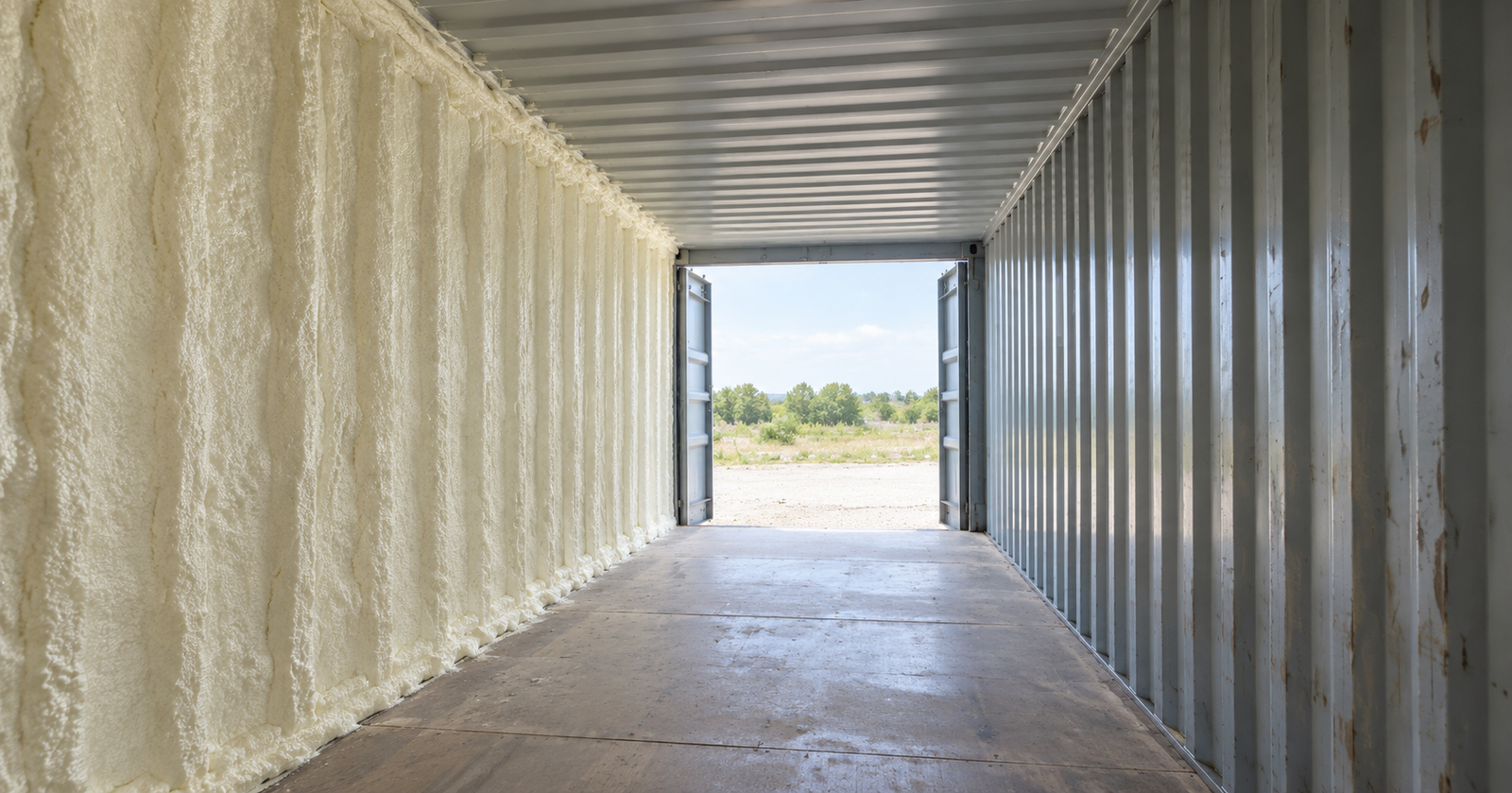
The type of foam changes what you get for the money. HomeGuide says open-cell foam provides only an air barrier, while closed-cell foam blocks both air and moisture. Closed-cell also insulates better per inch (R-5.0 to R-7.0, against R-3.5 to R-3.7 for open-cell). In the trade the price is per board foot, meaning one square foot at one inch thick, so a two-inch coat costs twice the one-inch figure. Ask what thickness sits behind any per-foot price, and know that HomeGuide says spray foam normally calls for a trained, certified installer.
Rigid foam board: check the unit before comparing
Rigid foam is missing from the table below on purpose. HomeGuide’s comparison table lists it at $1.20 to $3.70 in a column headed per square foot, while the section on rigid foam gives the same range per board foot. A two-inch layer priced per board foot costs double what the first reading suggests. If a quote includes rigid foam, ask which unit it uses before comparing it with anything else.
The three methods side by side
| Method | Installed price per sq ft | 20ft (about 570 sq ft) | 40ft (about 1,040 sq ft) |
|---|---|---|---|
| Reflective or radiant barrier | $0.30 to $2.00 | $170 to $1,140 | $310 to $2,080 |
| Batt and roll (framing extra) | $0.80 to $2.60 | $460 to $1,480 | $830 to $2,700 |
| Spray foam | $1.50 to $4.50 | $860 to $2,570 | $1,560 to $4,680 |
Calculated by ConexGuide. Illustrative, not a quote. Areas assume standard-height containers and count walls and ceiling only. Per-foot prices are HomeGuide’s installed ranges, and the spray foam range is where HomeGuide’s two published ranges overlap. The table leaves out the floor, framing, vapor barrier, interior finishes, delivery and any minimum project fee.
The low ends of several rows fall below the $1,000 to $8,000 that HomeGuide gives for insulating a finished container home, because the table leaves out framing, interior finishes and ventilation. The high ends sit well inside that range, and a home built from several containers would push toward the top of it.
What a fixed budget buys
Put $1,000 into a 20-footer and the reflective layer covers every surface with room to spare. Batts also fit if you do the work yourself, since materials come to $170 to $740 and framing is the other cost. Contractor-installed spray foam does not fit, because of the minimum fee described above.
At $2,500, professional spray foam on a 20-footer comes into range: $1,500 at the floor set by the minimum fee, $2,570 at the top of the calculated range. A 40-footer at the same budget works only at the low end of its foam range ($1,560 to $4,680).
At $5,000, spray foam on a 40-footer fits under the estimated pricing, even at the top of the range. That leaves little to spare, and extra moisture-control work could push the total higher. None of these totals include framing, finishes or ventilation, so read each budget as the insulation line and not the whole interior.
Do it yourself or hire it out
Labor is a separate line in HomeGuide’s data. It lists installation at $0.50 to $1.30 per square foot for batts, $0.20 to $1.40 for a radiant barrier and $0.60 to $1.10 for spray foam, and says contractors charge $40 to $80 or more an hour. On 570 square feet that is about $290 to $740 for batts, $110 to $800 for a radiant barrier and $340 to $630 for foam.
Labor is the part you keep by working yourself, so a do-it-yourself job on a 20-footer saves anywhere from about $110 to $800 depending on the method. Spray foam is the exception. HomeGuide says it normally needs a trained, certified technician, which makes it a hire-it-out job.
Where the room goes
A container is about 92 inches wide inside, and every layer takes some of it. Two inches of spray foam on each long wall leaves about 88 inches (7 ft 4 in), at R-10 to R-14 for closed-cell or R-7 to R-7.4 for open-cell. A 2×4 stud wall with fiberglass takes 3.5 inches per side and leaves about 85 inches (7 ft 1 in), at roughly R-8 to R-13, depending on the batt. The cheaper per-foot option costs three more inches of interior width, which matters in a space this narrow.
HomeGuide’s R-value recommendations for houses run R-13 to R-15 for garage walls and R-30 to R-60 for ceilings. Those are house guidelines, and the right level for a container depends on climate, use and local code, but they show the squeeze. Closed-cell foam reaches R-30 at 4.3 to 6 inches, which is a lot of headroom to give up in a box that is 7 ft 10 in tall inside. Two inches of it lands near the wall guideline and well short of the ceiling one.
What sits outside every figure above
The per-foot prices cover insulation, not what holds it in or covers it. Framing for batts, a vapor barrier, interior panels or drywall, the floor, and the door end are all separate lines. Ventilation is separate too, and none of the sources used here gives a price for it, so get one in writing. A good deal of the work also falls to whoever owns the box. Rented containers may require the owner’s permission before any modification, so this work mostly suits people who own the box, which is why the rent or buy a shipping container article treats modification as a reason to buy.
For the process itself, including how condensation forms and where the vapor barrier goes, see how to insulate a shipping container home to prevent condensation and heat loss. If the container is the start of a home build, insulation is one bill among several, and the container home site preparation costs article prices the ones that arrive before delivery.
Reading a contractor’s quote
HomeGuide advises collecting at least three quotes, each listing the areas to be insulated, the estimated R-value, the thickness, and the brand and type of material. That list works for a container job too. Add two questions of your own: whether the minimum project fee is already in the price, and whether framing, the vapor barrier and interior finishes are in or out.
Then multiply your own square footage by each quote’s per-foot price and set the result against the table. A total far above the range needs an explanation, since it may bundle framing or finishes. A total far below it may leave out the minimum fee or the vapor barrier. Ask about whichever one you find before you sign.