Gross rental income divided by the property’s housing payment is the key ratio behind DSCR financing. Unlike a traditional mortgage, a DSCR lender primarily evaluates whether the property’s rental income can support its debt obligations rather than relying primarily on your personal income or tax returns.
The Loan Built Around That Ratio
It’s called a DSCR loan (debt service coverage ratio), and per Griffin Funding’s guide, the formula is exactly what it sounds like: gross rental income divided by PITIA — principal, interest, taxes, insurance, and association dues. A ratio of 1.0 means the property’s qualifying rental income covers its PITIA, but the minimum required ratio varies by lender and program — some accept exactly 1.0, others prefer 1.20–1.25 or higher, and a few can work with a lower ratio given compensating factors. Truss Financial Group cites a threshold as high as 1.25x for some lenders, which underscores how much this varies rather than following one fixed rule.
Personal income documentation such as W-2s and tax returns generally isn’t the primary qualification method for this loan type. Newfi’s DSCR guide confirms this is the actual point of the product: qualification runs largely on whether the property itself can support the payment. That doesn’t mean your broader finances are irrelevant, though — credit, assets, down payment, and reserves still factor into approval, covered below.
Why FHA, VA, and USDA Loans Usually Don’t Work Here
This is worth stating directly, since it trips up buyers who assume the zero-down programs covered in our no down payment guide apply here too. LendingTree’s Airbnb financing breakdown is specific: government-backed owner-occupied programs have occupancy requirements that can make them unsuitable for a property intended purely as an investment Airbnb, and FHA specifically bars stays shorter than 30 days — which rules out most Airbnb-style use entirely. The one partial exception: VA loans can finance a no-down-payment multifamily property if you live in one unit and rent the rest, but that’s a narrower situation than a pure investment property.
Can a Container Home Actually Qualify for a DSCR Loan?
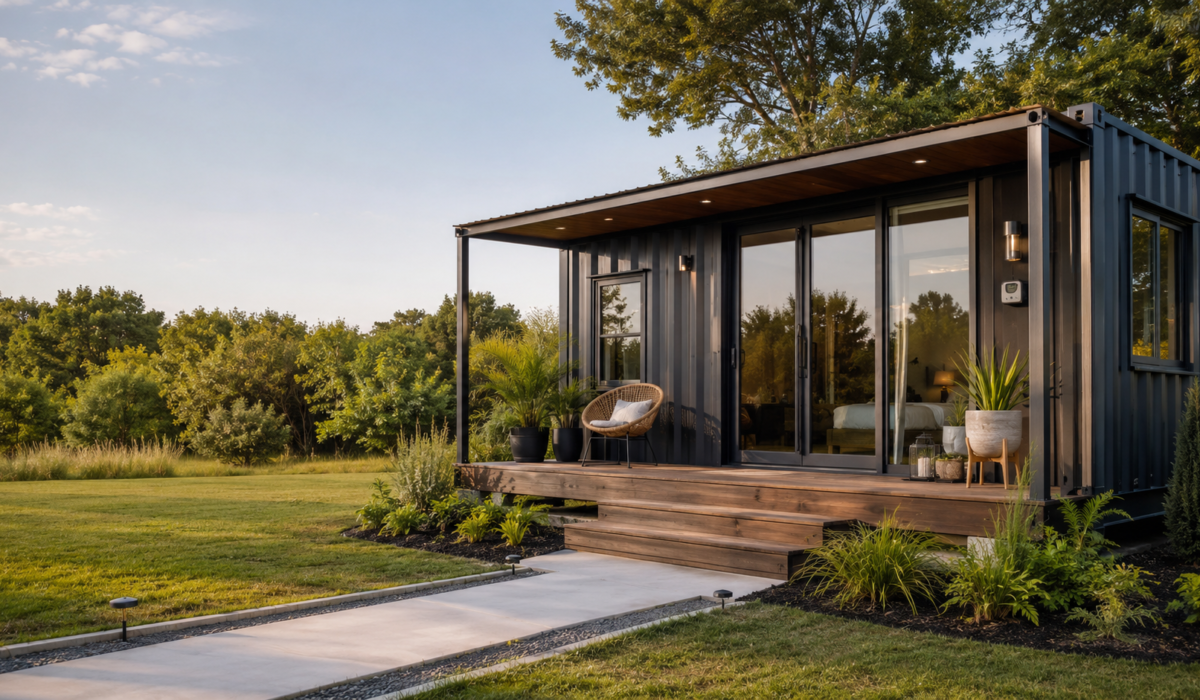
This is the question generic DSCR content doesn’t answer, since it’s specific to building on a container foundation rather than buying an existing conventional property. A few factors from elsewhere on this site carry directly into DSCR eligibility: the home generally needs real-property classification (permanent foundation, code compliance) the same way it does for any mortgage product, and it needs to pass appraisal with usable comparable sales — the same thin-comps issue covered throughout our financing guides applies here too. Beyond that, local zoning and short-term rental legality matter independently of financing (a lender won’t approve a loan for a use your municipality doesn’t permit), and you’ll typically need some evidence of realistic rental income potential — comparable local listings or a market rent estimate — to support the DSCR calculation itself.
What a DSCR Lender Actually Checks
- Credit score: requirements vary widely by lender; many look for scores in the 620–680+ range, with stronger scores generally unlocking better terms, per Griffin Funding, Truss Financial Group, and Awning’s 2026 STR financing guide
- Down payment: 20–30%, higher than a standard owner-occupied mortgage, per Baselane’s short-term rental financing overview
- Cash reserves: lenders may require several months of payments held in reserve; the exact requirement varies by lender, property, and loan program — some sources cite figures as high as 6–12 months, so confirm directly rather than assuming a fixed number
- Property condition: must be rent-ready — Visio Lending’s guide specifically requires “C4 condition,” meaning fully functional, structurally sound, and well-maintained before financing closes
That last requirement is worth sitting with if you’re financing a new container home build specifically for rental income, rather than an already-built property: the home generally needs to be genuinely finished and livable, rather than mid-construction, before a DSCR lender can underwrite it as a completed rental property. For a new build, a construction loan may be the more appropriate starting point — covered in our construction loan guide — with DSCR financing potentially becoming relevant once the property is complete and eligible for the applicable rental-property program.
The Real Tradeoff
Higher rate, in exchange for not relying primarily on personal income verification. Baselane puts the premium at roughly 0.5–1 percentage point above a standard mortgage rate — a real cost, but one that opens financing to buyers who couldn’t otherwise qualify on personal income alone, particularly useful if this would be a second or third property where a conventional lender might discount projected rental income altogether, as Awning notes traditional lenders commonly do.
Numbers to Bring to a Lender Conversation
Before reaching out, have a realistic answer for: your expected nightly rate and occupancy percentage (which produces your projected gross rental income), your estimated property taxes, insurance, and any HOA dues (which make up the rest of the PITIA denominator), and your available cash for both the down payment and reserve requirement. A lender will run the DSCR formula on these numbers before anything else — walking in with a realistic estimate already worked out speaks the same language the underwriting process actually uses.