What a container home costs before the container shows up
On this page
A 40-foot shipping container with delivery runs between $2,700 and $8,000, according to HomeGuide’s 2026 cost data. Plenty of container home budgets start with that number. In the comparison further down, even the lowest site-cost total is higher than the top price of the container. Container home site preparation costs are the bills that land before the steel does: paperwork, dirt work, a foundation, water, power and sewage. They are harder to estimate than the box, and they are the ones that wreck spreadsheets.
What follows takes those bills in roughly the order they arrive, using ranges mainly from two cost publishers that track contractor pricing, with two container home sites added for comparison. It ends with a two-lot comparison that ConexGuide calculated, so you can see how far apart two sites can land when the same container ends up on both.
The container is the cheap part
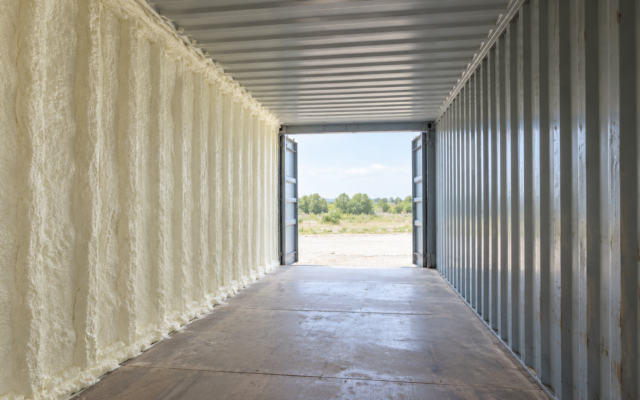
HomeGuide puts a one-trip 20-foot container at $2,000 to $4,000 and a 40-foot at $2,700 to $8,000, delivery included. The same page prices a whole single-container home at $25,000 to $80,000, so the box is a slice of the total, and often a thin one. Everything inside the walls comes on top: the same page lists insulation alone at $1,000 to $8,000, and the article on how to insulate a shipping container home goes through the options.
PERCH, a marketplace for modular and container homes, says something similar in percentages. It writes that site preparation, foundation, transport, crane setting and hookups add 40 to 60 percent to the factory module price. Another page on the same site puts the all-in total 60 to 80 percent above the structure price. The two pages describe different configurations, so read the figures as a direction and not as a formula.
Permits and planning come first, and the fees are small
HomeGuide lists a land survey at $200 to $1,200, a building permit for new construction at $500 to $2,000, and design plans at $100 to $2,000. Utility permits stack on top. Angi, which publishes its own cost data for putting utilities on raw land, reports septic permits at $450 to $2,300, well permits at $5 to $500, plumbing or sewer permits at $50 to $500, and electrical permits at $10 to $500. It also notes that you pay the permit fees even when a professional files the application for you.
The fees are small. The expensive part is what the permit office tells you. HomeGuide warns that many cities do not allow tiny container homes and says to check zoning and building codes before you buy anything. Angi starts its utility advice with the same kind of call: ask the local planning department whether the property can connect to public utilities at all. Make that call before closing on land. The answer decides if the budget gets a sewer tap or a septic field, and those can sit thousands of dollars apart.
Time belongs in the budget as well. Angi says setting up utilities on a vacant lot usually takes 6 to 16 weeks, from planning review through permits, trenching and the final connection. If you are paying rent or carrying a land loan during those weeks, that cost sits outside every range quoted for a single item.
Dirt work: clearing, digging, leveling
HomeGuide prices clearing trees, stumps, brush and rocks at $1,200 to $8,000 per acre. Excavating for a tiny home foundation runs $1,000 to $2,500, and grading a small area so water drains away runs $500 to $1,000. A lot that was farmed or mowed for years may need none of the clearing. A wooded lot may need all of it. Either way a delivery truck has to reach the spot, and a driveway is not part of any of those figures.
Foundation quotes can span more than a sixfold range
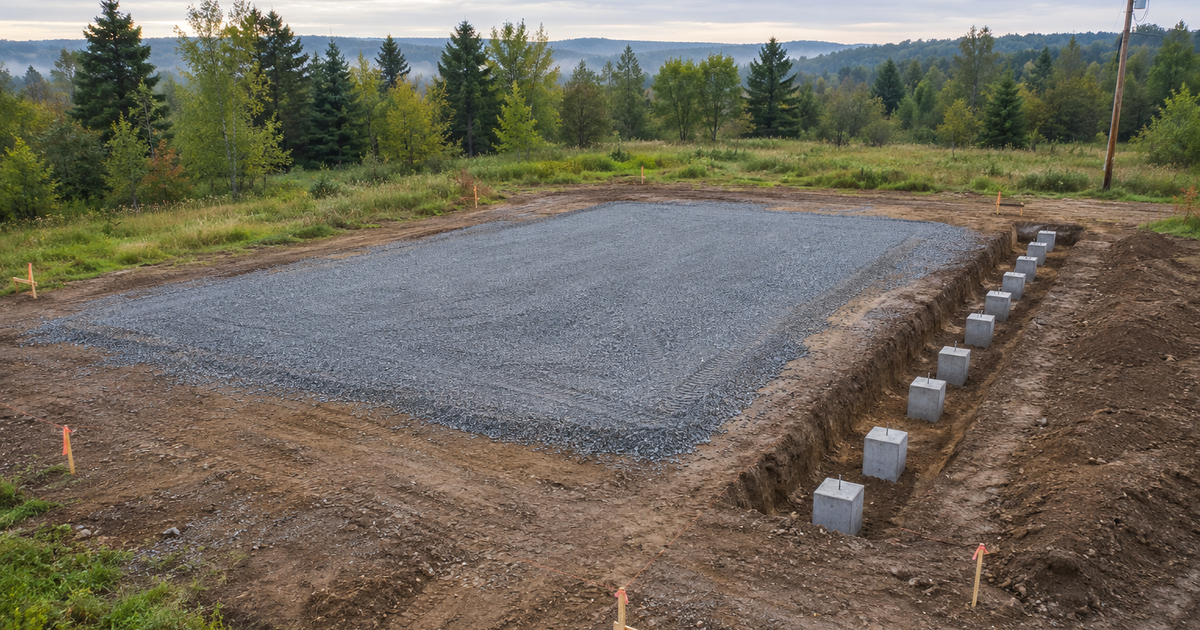
For a container home foundation, HomeGuide gives $3,000 to $19,350, which puts the top of the range about 6.5 times above the bottom. The range spans different foundation types and site conditions, so it is not one job priced two ways. A concrete slab is the cheapest type at $5.75 to $13.50 per square foot, and the same page says pier footings and crawlspace foundations land toward the high end.
Other sources land elsewhere. ContainerCompass, a container home guide site that carries affiliate offers, lists pier foundations at $4,000 to $8,000 and a concrete perimeter foundation for a two-container home at $12,000 to $18,000. It adds that piers may not satisfy code in every area. PERCH says frost depth in the upper Midwest calls for footings 42 to 48 inches deep, which it says adds $5,000 to $12,000 compared with a southern build.
Put those together and a pattern shows up: climate and local code pick the foundation type before price does. Two quotes for the same container can differ by thousands because one describes piers and the other describes a frost-protected slab. When quotes come in, ask which foundation each one prices, whether excavation and backfill are included, and who produces the plans the building department will ask for.
Utilities are priced by the foot
Angi reports $6,500 to $30,000 for getting utilities onto land in 2026, with a national average of $20,400. Its component ranges: city water at $1,000 to $6,000, city sewer at $1,500 to $5,700, a drilled well at $5,000 to $10,000, and a septic system at $3,400 to $11,500. Electricity costs about $1,000 when lines already reach the property, or $5 to $15 per linear foot when they do not. Trenching runs $400 to $1,200 per 100 feet, and a new transformer, if the utility requires one, adds $3,000 to $7,000.
Distance is the biggest driver. Angi says contractors charge by the linear foot for trenching and pipe, with septic and well work at $60 to $120 per foot and a public water connection reaching $200 per foot. A septic system also has to sit a set distance from neighboring homes, so the shortest run is not always the legal one.
ContainerCompass quotes higher for remote sites: $10,000 to $50,000 or more to run electricity, water and sewer. That ceiling is well above the $30,000 top of the Angi range, and it shows how one remote parcel can break a national average.
Angi’s savings advice is practical. Put water, power and phone lines in one trench, place the house close to existing lines, and split the cost of a well with a neighbor if one is willing.
Two lots, same container
Both lots get a 40-foot container home on a foundation. Lot A is already cleared and has city water, city sewer and power at the lot line. Lot B is a raw acre with trees to clear, no public water or sewer (so a well and a septic system), and 500 feet to the nearest power line. Each figure below uses the low and high ends of the HomeGuide and Angi ranges described above.
| Cost line | Lot A (low to high) | Lot B (low to high) |
|---|---|---|
| Land survey | $200 to $1,200 | $200 to $1,200 |
| Clearing, 1 acre | none | $1,200 to $8,000 |
| Excavation | $1,000 to $2,500 | $1,000 to $2,500 |
| Grading | $500 to $1,000 | $500 to $1,000 |
| Building permit | $500 to $2,000 | $500 to $2,000 |
| Utility permits | $60 to $1,000 (plumbing or sewer, electrical) | $465 to $3,300 (septic, well, electrical) |
| Foundation | $3,000 to $19,350 | $3,000 to $19,350 |
| Water and wastewater | $2,500 to $11,700 (city water and sewer) | $8,400 to $21,500 (well and septic) |
| Electric | $1,000 to $1,500 | $2,500 to $7,500 (500 ft at $5 to $15) |
| Total | $8,760 to $40,250 | $17,765 to $66,350 |
Calculated by ConexGuide, from the HomeGuide and Angi ranges above. Illustrative, not a quote. Lot A’s $1,000 electric figure is Angi’s cost when lines already reach the property, and the $1,500 high end is HomeGuide’s upper figure for a grid connection. Excavation and foundation are separate lines here, but some contractors bundle them into one quote, so check for overlap before adding. The table leaves out the container itself (HomeGuide’s container price already includes delivery), crane placement, a driveway, a transformer, design plans and everything inside the walls.
Lot A’s low total, $8,760, is already above the top price of the container itself ($8,000). Lot B’s low total, $17,765, is more than double that. The gap between the two lots is about $9,005 at the low end and $26,100 at the high end, and most of it comes from water, sewage and power. Those are ends of ranges, not predictions: neither the cheapest nor the costliest outcome is likely, and a real lot lands somewhere between.
That gap matters when comparing parcels. At the low end, a raw acre has to be about $9,000 cheaper than a serviced lot to break even on site costs, and at the high end about $26,100 cheaper. HomeGuide puts average land at $5,000 to $18,000 per acre, so the extra site cost on Lot B can be larger than the land itself.
What to ask before you accept a utilities or foundation quote
Angi recommends collecting estimates from at least three installers and reading what each one includes before leaning toward the lowest number. For utilities, ask whether the quote covers the meter, the permits, restoring the ground after trenching, and any connection fee the utility company charges separately. That last one can be large: HomeGuide says some cities charge $2,000 to $3,000 or more for the water meter alone, on top of $32 to $53 per linear foot for a new water main.
Before you make an offer on land
Three phone calls cost nothing and move this budget more than any design decision. Call the planning department and ask whether a container dwelling is allowed on the parcel and whether sewer or septic applies. Call the electric and water providers and ask how far the nearest line is and what the connection fee is. Call a local foundation contractor and ask what frost depth and soil do to the quote in that county.
Then take the land price and add the container home site preparation costs from the column that matches the parcel. That figure, with written quotes behind it, is what to bring to a construction loan for a container home conversation. The financing half of the same budget is laid out in the total cost of financing a container home. Get the zoning answer and the written utility estimates before earnest money goes down.